

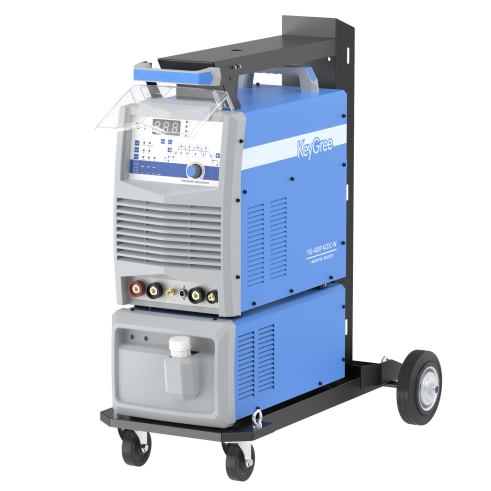
TIG-400PACDC-W: The Mobile, Water-Cooled Welding Solution for Demanding Applications
I. Core Positioning and the Core Issues to be Solved
The core of this equipment is a 400A-class industrial multi-functional digital TIG (tungsten inert gas) welding machine.Its integrated AC/DC design enables it not only to weld carbon steel and stainless steel, but also to weld aluminum, magnesium, and their alloys, which are extremely sensitive to welding heat input.Its "integrated trolley and water tank" configuration is not merely a simple addition of accessories, but a systematic response to the following three major categories of practical engineering problems:
1.Thermal management and stability under continuous heavy load operation
Industries like pressure vessels, chemical pipelines, and shipbuilding demand continuous, high-current welding—often for hours at a time. Traditional air-cooled welding machines have a low duty cycle (e.g., 35%), necessitating shutdown for cooling after a period of welding, severely slowing down project progress. Furthermore, accumulated welding heat can easily lead to workpiece deformation and performance degradation. Overheating of the welding torch can also cause difficulty in arc ignition and arc instability.
2.The contradiction between mobility, integration and space occupation in on-site construction
In scenarios such as construction site installation, large equipment maintenance, and field pipeline construction, work sites are scattered. Welding machines, cooling water tanks, gas cylinders, cables, and other equipment are separated, making them difficult to move. On-site wiring is messy, not only taking up valuable space but also posing a tripping hazard. Furthermore, the complex wiring increases the difficulty of troubleshooting.
3.It is difficult to meet the requirements for consistent welding quality and special processes.
Welding thin stainless steel sheets is prone to burn-through and deformation; controlling the molten pool is difficult during overhead welding or bevel filling, easily resulting in incomplete fusion or poor weld formation; traditional equipment is difficult to adjust when producing aesthetically pleasing fish-scale patterns; and "arc deviation" may occur due to current interference when multiple welding machines are operating in tandem.
Keygree's TIG-400PACDC can completely solve these problems.
Solution1:
Integrated water-cooling system: Directly circulating water cools the welding torch and key components of the welding machine, significantly increasing the system's heat capacity. This allows its effective duty cycle to reach 60% or even higher, enabling longer periods of uninterrupted welding at rated current. This directly solves the problem of low production efficiency caused by equipment overheating shutdowns.
Digital precision control and low-current arc stabilization: Powered by fully digital IGBT inverter technology, the machine delivers pinpoint control over current waveforms—whether square wave for aluminum or pulse for thin stainless steel—ensuring optimal results for every material. Its ability to stably initiate and maintain an arc even at low currents (as low as 10A) is crucial for root pass welding of thin-walled pipes and controlling the arc initiation point of precision parts, preventing arc initiation failure or excessive current burning through the workpiece.
Solution2:
Integrated Mobile Cart: This design integrates the welding machine, water-cooling tank, and even argon cylinders (usually designed with fixed positions) onto a robust, wheeled frame. This enables rapid deployment of a complete "welding workstation." Workers can quickly move the entire system to the next workstation, much like pushing a tool cart, saving the physical effort and time of repeated disassembly and reassembly.
Simplified Site Layout: The built-in water tank reduces external piping, and the centralized design allows for more standardized cable and gas line management, significantly improving the 6S (Sort, Set in order, Shine, Standardize, Sustain, Safety) level of the work site and reducing safety hazards.
Solution3:
Advanced Waveform and Pulse Functions: The pulse TIG function provided by the equipment is key to solving these problems.
Low-Frequency Pulse (0.1-10Hz): Melts the base material with peak current, while the base current maintains the arc and cools the molten pool. Particularly suitable for all-position welding (e.g., overhead, vertical welding), effectively controlling molten pool flow.
Medium-High Frequency Pulse (10-250Hz): Arc contraction, concentrated energy, and low heat input. Perfectly suited for high-speed welding of thin stainless steel and titanium alloys, greatly reducing deformation. By adjusting the frequency and travel speed, a uniform and aesthetically pleasing fish-scale weld pattern can be formed.
Process Storage and Interface Expansion: Some high-end models may be equipped with a USB interface or digital menu, allowing the import, storage, and retrieval of welding parameter packages optimized for specific materials and thicknesses. This enables even beginners to quickly replicate the techniques of advanced welders, ensuring consistent quality. Reserved IoT and communication interfaces provide possibilities for future integration with automated welding systems or group control management (preventing multi-machine interference with arc deviation).
Based on the above problem-solving capabilities, the application scenarios of this device can be clearly divided into three levels:
1. Pressure Piping and Chemical Equipment Pipeline root pass welding requires high precision in single-sided and double-sided forming; continuous welding necessitates precise control of heat input; frequent on-site workstation movement is required. The pulse function ensures proper back-side weld formation for the root pass; the water-cooling system supports long-duration welding; the mobile trolley adapts to pipeline construction.
2. Stainless Steel Products and Precision Machining Thin plate welding requires deformation control; welds must be aesthetically pleasing (fish-scale pattern); strict requirements apply to the heat-affected zone. High-frequency pulses significantly reduce heat input; multiple waveforms optimize weld formation; low-current arc stabilization ensures high-quality arc initiation.
3. Aluminum Alloy Structure Manufacturing Aluminum oxide film cleaning requires AC power; rapid heat dissipation during welding necessitates a centralized heat source. Integrated AC/DC converter; AC welding allows for oxide film removal; the pulse function concentrates arc energy, increasing penetration depth.
Conclusion
The TIG-400PACDC-W (with integrated carriage and water tank) is more than just a welding machine; it's a mobile precision thermal processing platform designed to meet the challenges of "high quality, high efficiency, and high flexibility" in modern industrial welding. It solves the problem of construction flexibility through physical integration (mobile carriage), the problem of heavy-duty continuous operation through system integration (water cooling), and the problem of complex processes and quality consistency through digital integration (intelligent control).
Its value lies in freeing welders from heavy equipment handling, complex parameter adjustments, and frequent troubleshooting, allowing them to focus more on the welding process itself. For any operation that demands versatility, mobility, and uncompromising quality—whether in the shop or on-site—the TIG-400PACDC-W isn't just an equipment purchase. It's an investment in shorter project cycles, lower total costs, and consistently superior welds.
Keygree Group Co., Ltd.
Keygree Group Co., Ltd.
+86 18058395375
info@keygree.com
Legal Disclaimer:
EIN Presswire provides this news content "as is" without warranty of any kind. We do not accept any responsibility or liability for the accuracy, content, images, videos, licenses, completeness, legality, or reliability of the information contained in this article. If you have any complaints or copyright issues related to this article, kindly contact the author above.
